
If you want businesses in the week their website goes live, Apollo is the wrong shape of tool, and a launch-day feed such as Vetted Leads or FisherLeads is the better fit. If you sell to companies that already exist and need a named decision maker, stay with Apollo or look at Hunter, Lusha or Snov.io. Of those, Lusha also sells phone numbers.
Apollo is built to find people at companies that have been around long enough to be in a database. Apollo's pages do not say it finds a bakery that put its site up on Monday, and on Monday that bakery is also the business most likely to need a designer, an SEO pass or someone to set up its first ads. All facts about other tools below come from their own pages, as of November 2026.
Who should leave Apollo, and who should stay?
Apollo describes itself as "one connected GTM system": a contact database, AI agents that write outreach and follow up, sequencing and CRM integrations in one product. Its homepage gives the database as 240M contacts and 30M companies. That is a lot of reach, and for many sales teams it is the right tool.
Freelancers and small agencies usually look for an Apollo alternative because:
- They sell to brand new businesses. A web designer offering a first redesign, an SEO person offering a launch audit, or an ads freelancer offering pixel and campaign setup wants the business in its first days, before it has hired anyone. Apollo's pages say its data is "regularly updated to stay fresh" but give no schedule, and they do not say it finds businesses on the day they launch.
- They want the site's problems, not a person's job title. A small business owner is usually the only person there. What makes a cold email land is something specific about their site, and a people database does not tell you that.
- They want a smaller, simpler tool. Sequencing, deliverability tools and CRM integrations are useful at volume. A solo freelancer sending ten careful emails a week may not need them.
| If you are... | Lean towards | Why |
|---|---|---|
| Selling sites, SEO or ads setup to businesses in their first week | A launch-day feed: Vetted Leads or FisherLeads | Finds the business around the day its site goes live |
| Selling to established companies with a buying team | Apollo, Lusha or Hunter | Named decision makers at companies that already exist |
| Finding or checking the email of one person you already know about | Hunter or Snov.io | Built around finding and verifying a named person's work email |
| Running high volume outbound with sequences and CRM integrations | Apollo | Database, sequencing, deliverability tools and CRM integrations in one product |
How do the Apollo alternatives compare?
Prices are as each company's own page shows them, in US dollars, as of November 2026. Apollo's prices were read in a browser with monthly billing selected, since its page only shows them once it has loaded.
| Tool | Cheapest paid plan | Free option | How fresh | Platforms or coverage | Contact data | AI writes outreach |
|---|---|---|---|---|---|---|
| Vetted Leads | Starter, see pricing for your currency | 3 contacts once and the newest 50 leads each day, no card | Launch day: a site is found when its first certificate is issued | New businesses and online stores on WordPress, Shopify, WooCommerce, Wix, Squarespace, Framer, Webflow and custom sites | The business's own email, checked with its mail server, plus social links | Yes, Freddy, on Pro and Business |
| Apollo | Basic, $65 a seat a month, 2,500 credits a month | Free plan, no card, 75 credits a month | "Regularly updated", no schedule given | 240M contacts, 30M companies | Verified emails and phone numbers of named people | Yes, agents write outreach and follow ups |
| Hunter | Starter, $49 a month ($34 billed yearly), 2,000 credits | 50 credits a month | No schedule given; suggests new prospects every week | 150,430,313 email addresses verified | Work emails of named people, with a verifier | Yes, an AI writing assistant |
| Lusha | Starter, $49.90 a month ($37.45 billed yearly), 400 credits | 40 credits a month, no card | Contact fields refreshed weekly | 515M+ contacts, 29M+ companies | Emails and phones of named people, each email with a confidence score | Not mentioned; its AI recommends accounts and contacts |
| Snov.io | Starter, $39 a month ($29.25 billed yearly), 1,000 credits | Trial plan, 50 credits renewing every 30 days, no export, no card | No schedule given | 500M+ B2B email addresses | B2B emails found by name, company or LinkedIn, with a 7 step verifier | Yes, an AI email writer |
| FisherLeads | Premium, $50 a month, 5,000 exports | Browse a daily sample free, no card | Says it finds new stores and sites the day they go live | 30+ platforms, new stores and business websites | Founder email and socials where available, plus the site's contact page | Yes, an outreach agent called Finn |
Two of these are launch feeds: Vetted Leads and FisherLeads. The other four are databases of people at companies that already exist. That is the first choice to make. So decide which kind you need before you compare prices.
When Apollo is the better pick
Stay with Apollo if any of these is true:
- You need a named person. Apollo lists verified emails and phone numbers of individual decision makers. Vetted Leads gives you the business's own published email and social links, not a decision maker's phone number.
- You sell to companies with a buying team. If your client has a marketing director, a procurement process and a budget cycle, a database of 30M companies is the right place to start. A business that launched this week will not have any of that.
- You want the whole outbound stack in one place. Apollo bundles sequencing, deliverability tools such as domain warming and inbox rotation, and CRM integrations. Vetted Leads has none of the deliverability tools and no CRM integrations; you export a CSV or connect an AI app.
- You need history. A launch feed only holds recent launches. Vetted Leads takes a site in only while it is 7 days old at most, so it is not where you look for a company founded in 2019.
If that describes your work, the closest alternatives are Hunter, Lusha and Snov.io, not a feed.
What does each Apollo alternative do well?
Hunter
Hunter calls itself an all-in-one email outreach platform. Its core is the Domain Search, Email Finder and Email Verifier. The Domain Search and Email Finder return work emails of people at a company, and the verifier gives each address a status and a confidence score. Its pages say it has verified 150,430,313 email addresses. It also has sequences, an AI writing assistant and buying signals.
It is stronger than a feed when you already know which company you want and need the right person's address. The free plan gives 50 credits a month, and every plan has unlimited team members. Its pages do not say whether it finds businesses on the day they launch.
Lusha
Lusha sells a B2B data layer: contacts, companies and buying signals such as funding, hiring and job changes. Its pages give 515M+ verified contacts and 29M+ companies, with contact fields refreshed weekly. A verified email costs 1 credit and a phone number 5, and each email comes with a confidence score and a last updated date.
It is the pick when you need phone numbers and signals about established companies. Its AI recommends accounts and contacts; writing the outreach is not mentioned.
Snov.io
Snov.io combines an email finder, a verifier and email and LinkedIn campaigns. Its Email Finder page gives a database of 500M+ B2B email addresses. The verifier runs seven checks, including connecting to the mail server to make sure it can receive messages, and it sends no mail while it checks. You can run that verifier on any list you already have.
The free Trial plan renews every 30 days with 50 credits, but it has no export. Snov.io is a good fit if you want finding, checking and sending in one tool. Its Starter plan, $39 a month as of November 2026, is the cheapest paid plan among the tools here that print a price.
FisherLeads
FisherLeads is the closest tool to Vetted Leads here. It sells a live feed of newly launched online stores and business websites and says it detects them the day they go live. It tracks 30+ platforms, publishes its methodology and an accuracy audit, and has directories by trade and country, a REST API, webhooks, Zapier and a free browser extension. Its AI agent, Finn, finds the founder, writes an email and sends it from your own mailbox.
If you want the widest platform list and an API, FisherLeads is strong. We compare the two in detail in FisherLeads alternatives.
Vetted Leads
Vetted Leads (that is us) reads the public certificate transparency logs, where every new HTTPS certificate is recorded, so a site turns up the day its first certificate is issued. Then it visits the site, checks it is a real business and not a parked page or a hobby blog, and lists what the homepage is missing.
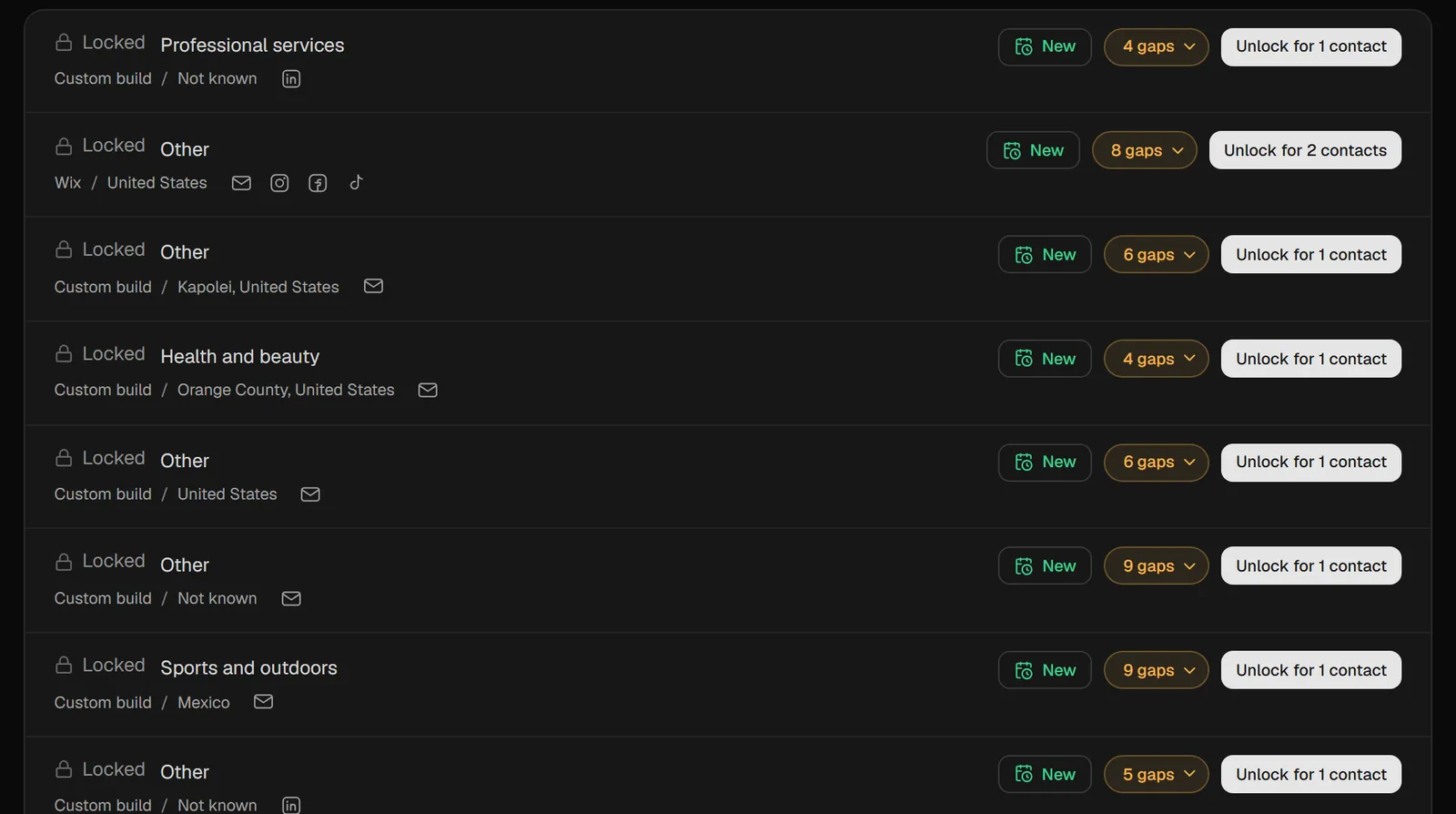
Every email is checked with its domain's mail server before it reaches the feed, and only the addresses the server confirms are kept. On Pro and Business, Freddy drafts the first message from the site's gaps. On the paid plans, an AI app connector lets Claude, ChatGPT or Cursor search the feed for you, and CSV export has no cap.
What it does not do: it has no named people or job titles, no phone numbers, no revenue estimates and no CRM integrations. It does not replace Apollo. It does one narrower job: newly launched businesses, what their websites are missing, and an email its mail server has confirmed. There is a side by side table in Vetted Leads vs Apollo.
ZoomInfo
ZoomInfo is a large B2B contact and company database. We could not read its plans or prices this month, so it is not in the table.
Why does a business's first week matter for your pitch?
A business that just put its site up is making a run of decisions at once: who builds the next version, who handles search, who runs the first ads, which email tool to use. Plenty of owners put a site up from a template and plan to fix it later. In the first week, "later" has not been handed to anyone yet.
The gaps on a new site are usually visible from the outside. Here are some of the gaps Vetted Leads measures, on the homepage, with public tests and from public DNS, and what each costs the business:
| Gap on the new site | What it costs the business | What you can offer |
|---|---|---|
| No meta description | Search engines write their own line under the result, often menu text | A written description for each main page |
| No social preview image | Shared links show a blank card on social apps and messengers | A preview image and the tags behind it |
| No structured data | No rich results, and less for search engines to read | Organization or LocalBusiness markup |
| Images with no alt text | Lost image search traffic, and screen readers read nothing | An accessibility and alt text pass |
| Slow on Google's phone test | Visitors on phones leave before the page loads | Image compression and a speed pass |
| Copyright year behind | The site looks abandoned to a first time visitor | A small content refresh, often an easy first job |
| No DMARC record | The business's own emails are easier to spoof and more likely to land in spam | Email authentication setup |
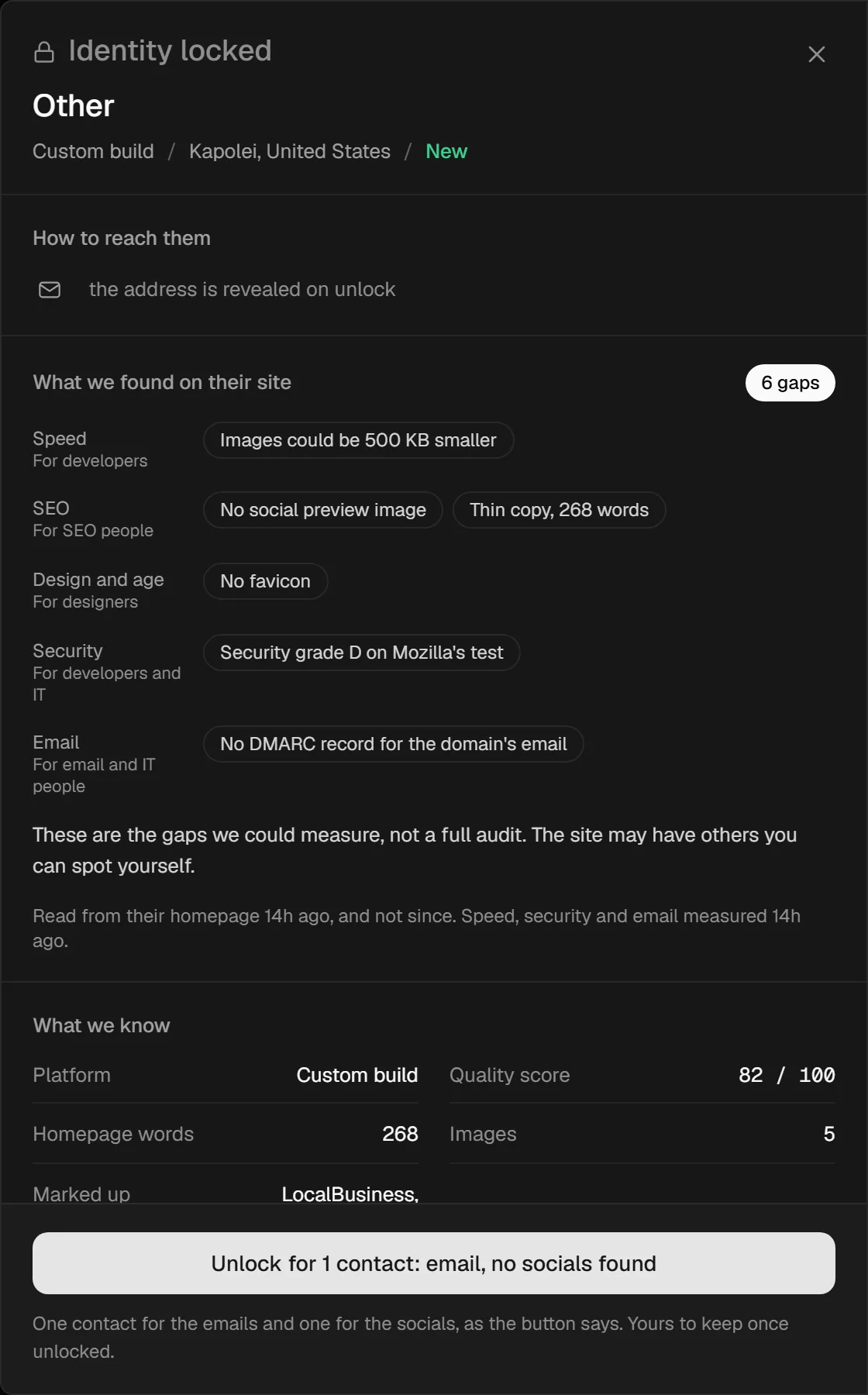
These are what can be measured from the homepage, public tests and public DNS, not a full audit.
How can you check that a business is really new?
Whichever tool you use, check before you pitch. It takes two minutes:
- Look up the domain's age. An RDAP or WHOIS lookup at the registry gives the date the domain was registered. A domain registered last week is a better sign than a tool's label.
- Look up the first certificate. A certificate log search such as crt.sh shows when the site's first HTTPS certificate was issued, which is close to the day it went live.
- Load the site. A parked page, a "coming soon" page or a host's default page is not a business yet.
- Read the homepage as a customer would. A real business says what it sells and how to reach it. A test site or a blog with no offer is not your client.
What should you send a business you found this week?
Keep the first message short, about one thing you saw, and ask for something small. For example:
Subject: the preview for yourbakery.com
Hi Sam, congratulations on the new site. I noticed that when someone shares a link to it, the preview shows a blank card with no picture, so it looks unfinished on social apps. It is about a 30 minute fix: an image and two tags. Want me to send you a mock-up of how it would look?
Jo, web designer
It names one gap, says what it costs in the owner's terms, and asks for a yes to something small. Keep it under 120 words and send one follow up after four or five days. That part is the same whichever tool found the business.
Which Apollo alternative should you pick?
- Businesses found on launch day: Vetted Leads or FisherLeads. Vetted Leads checks every email with its mail server and lists each site's gaps. FisherLeads covers more platforms and has an API.
- Named people, phones or the whole outbound stack at established companies: Apollo, or Hunter, Lusha or Snov.io.
If your work is setting up new businesses online, try a launch feed before you pay for anything. Vetted Leads gives you 3 free contacts once and the newest 50 leads each day, no card. For software sellers who want businesses in their first week rather than established companies, the page for software companies shows the filters that find them.
Questions people ask
Is there a free Apollo alternative?
Several have free plans, as of November 2026: Hunter gives 50 credits a month, Lusha 40 credits a month, and Snov.io a Trial plan of 50 credits that renews every 30 days but has no export. Vetted Leads gives 3 free contacts once and the newest 50 leads each day, with no card. Apollo itself also has a free plan with no card.
Which Apollo alternative finds businesses that just launched?
Apollo, Hunter, Lusha and Snov.io are databases of people at companies that already exist, and their pages do not say they find businesses on the day they launch. Vetted Leads and FisherLeads are launch feeds: both say they find new sites around the day they go live. Vetted Leads finds a site when its first certificate is issued in the public certificate logs.
Does Vetted Leads replace Apollo?
No. Apollo has named decision makers with phone numbers, sequencing, deliverability tools and CRM integrations. Vetted Leads does a narrower job: businesses found on the day their site goes live, what their websites are missing, and the business's own email, checked with its mail server. If you sell to established companies with a buying team, Apollo or a similar database is the better fit.
How much does Apollo cost?
Apollo's Basic plan is $65 a seat a month on monthly billing, with 2,500 credits a month, as its pricing page showed in November 2026. Professional is $99 a seat a month and Organization $149 a seat a month for at least 3 seats, billed annually only. There is also a free plan with 75 credits a month.
Which tool is best for finding one person's email?
Hunter and Snov.io are built for it. Both have an email finder and a verifier, and Snov.io's finder searches by name plus company domain. Lusha also returns emails, with a confidence score, and phone numbers for 5 credits each.